

Reciprocal Treaty: The Age-Old Treaty: Reciprocity in Leadership
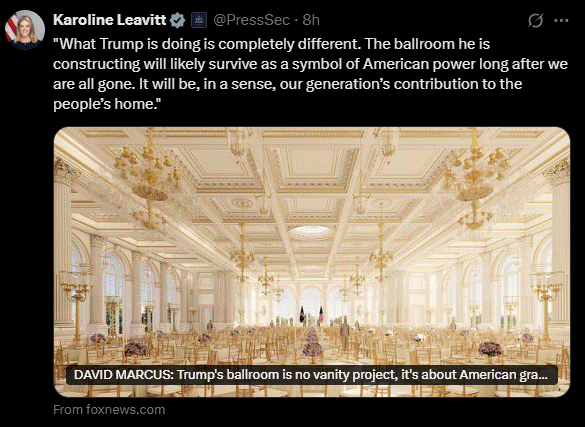
The world is shifting, and with it, the understanding of an ancient truth: reciprocity governs all. As Karoline Leavitt recently invoked, the age-old saying remains unchanged—treat others as you wish to be treated. But in today’s landscape, it is not just a moral guideline; it is the foundation of global leadership.
We are witnessing the parable unfold before our eyes. World leaders already operate by this principle—actions are met with equal reactions, diplomacy with diplomacy, strength with strength. This is not new; it is a lesson humanity has always known, though often forgotten until necessity forces its return. There is no need for shock, only understanding. Absorption retains memory best, and it is through this understanding that we shape the generations to come.
The idea of a reciprocal treaty is not confined to paper agreements between nations. It extends to policy decisions, economic strategies, and even cultural expectations. When a nation offers fairness, it receives fairness in return. When it exercises force, it invites force upon itself. The world operates in balance, and those who grasp this concept wield the greatest influence.
The United States stands at a pivotal moment. With the leadership of President Trump and the voices emerging in the next wave of governance, this understanding must guide our course. We cannot afford to ignore the reality that reciprocity is already in play—whether through trade negotiations, military strategy, or the restructuring of internal governance.
If we expect honesty, we must operate with transparency. If we demand accountability, we must first exemplify it. This is the true essence of leadership, and it is the legacy that must be cemented for the future.
The world watches, as it always has, to see how we will respond. The choice is ours: to lead with the wisdom of age-old truths or to stumble through cycles of forgotten lessons. Let us not choose the latter.
Our words, our actions, and our integrity will define the path forward. Reciprocity is not merely a principle—it is the inevitable force shaping the future. Let us ensure that the lesson is not just relearned but mastered for the generations that follow.
That framework makes this even more powerful—because at its core, governance, economics, and social structures all stem from the dynamics of family. Nations function as families do: with leadership, responsibility, reciprocity, and consequences.
A Framework of Reciprocity Through the Family Lens
The Father (Leadership & Governance) – The guiding force, providing structure, making decisions, and ensuring stability. The father’s role is to set the foundation and lead by example. In governance, this represents leaders who set policy, enforce accountability, and define the moral compass of a nation.
The Mother (Nurturing & Economy) – The stabilizing force, ensuring sustainability, nurturing growth, and managing resources wisely. In a nation, this reflects economic policies, trade agreements, and financial systems—ensuring that resources are distributed fairly and effectively.
The Children (The People & Culture) – The future. They inherit the lessons and consequences of leadership and economic choices. The people—citizens, businesses, and communities—reflect and react to what the leadership and economy provide. Culture, innovation, and social movements arise from their experiences.
Applying This to Global & Local Reciprocity
If leadership acts with strength and fairness, the economy thrives, and people are empowered.
If leadership falters, the economy suffers, and society reacts—protests, instability, and distrust emerge.
If economic forces become corrupt or unbalanced, the people suffer, and leadership is challenged.
This model plays out in every nation, every local government, and even within companies and families. It is the universal truth of reciprocity: leadership, nurture, and reaction.
Where do you want to take this next?
Amanda Jackson



 The Metaphorical
Leave a Reply