

Abstract
Throughout history, humanity has sought to define itself through various lenses—science, philosophy, social constructs, and even identity politics. Yet, in the pursuit of complexity, we often overlook the simplest, most undeniable truths embedded in the very structure of existence. This thesis presents an argument rooted in mathematics, biology, and historical precedent, using prime numbers and the family tree as metaphors for the essential nature of duality in human continuation.
The irony of our time is that as civilizations claim to be advancing, many are abandoning the fundamental principles of multiplication and growth—both mathematically and biologically. This paper outlines why the connective coincidences between prime numbers, reproduction, and societal evolution are more than mere happenstance; they are intrinsic laws that dictate whether a species thrives or fades into history.
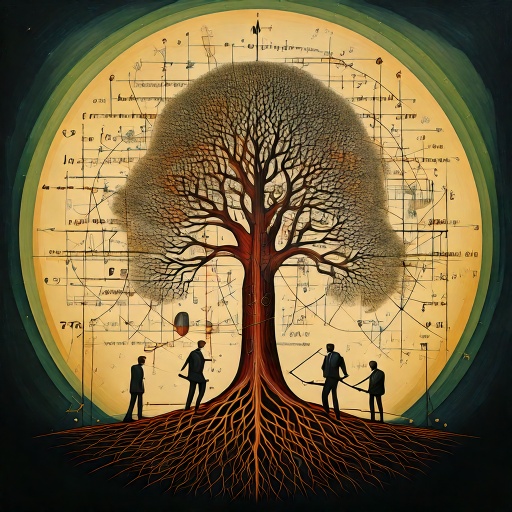
Introduction: The Undeniable Truth of Multiplication
Mathematics is the language of the universe. It does not change based on emotion, preference, or ideology. Prime numbers—numbers divisible only by one and themselves—represent an indisputable natural order. Likewise, the family tree, as a biological and social structure, mirrors the fundamental requirements for human existence.
Both reveal a truth that cannot be rewritten: One alone does not multiply. Two is required for creation. And without creation, there is no future.
Societies that attempt to defy this truth—whether through philosophical reasoning, ideological shifts, or technological workarounds—inevitably face extinction. This paper will explore:
- How prime numbers symbolize the necessary foundation of human reproduction and societal expansion.
- How the family tree follows the same structure, proving that multiplication is the only path forward.
- How civilizations that ignored or rejected these principles have collapsed.
- The modern illusion that technology or ideology can override these natural laws.
- The ultimate question: Will we listen to the numbers, or will we become a cautionary tale?
The Mathematical Basis: Prime Numbers and Multiplication
Prime numbers hold a unique place in mathematics: they are fundamental, indivisible, and essential to all numerical systems. Likewise, biological reproduction requires a similar fundamental pairing.
1. The Inescapable Role of “Two”
- 1 stands alone. It cannot multiply. It exists in a vacuum.
- 2 is the first prime number. It is the first number capable of initiating growth.
- With 2, we get 3, another prime. But without 2, there is no 3, no 5, no 7—no continuation of the sequence.
The same applies to humanity. Without the pairing of two individuals, the species ceases to move forward. A single entity cannot multiply. This is not a moral stance; this is pure mathematical fact.
Mathematically, the number one is self-contained—it is an isolated entity that cannot generate anything beyond itself. It remains static, locked in its singular existence. In contrast, the number two is the first prime number capable of multiplication, representing the beginning of expansion. Without two, numerical growth is impossible. This principle mirrors biological reproduction, where a single entity cannot propagate its lineage alone. The necessity of two is not a matter of ideology; it is a foundational truth embedded in the very structure of mathematics and biology. Without two, the sequence of existence is broken, halting progress indefinitely.
The concept extends beyond mere arithmetic. The prime number sequence follows an inherent order, and without two, there is no three, no five, no seven—no continuation of structured progression. Just as mathematical sequences require foundational numbers to build upon, humanity requires the pairing of two individuals to sustain itself. This is not a subjective or moral assertion but an observable, logical reality. The principle of multiplication is inescapable: without an initiating factor, there can be no continuity.
2. Prime Numbers and Growth Patterns
- You cannot have five without first having four.
- You cannot have the next prime without preceding numbers forming a foundation.
- Prime numbers do not appear randomly; they follow an inevitable, sequential order—just like generational lineage.
Prime numbers do not emerge randomly but follow an ordered sequence built upon preceding numbers. The number five cannot exist without four; eleven cannot exist without ten. This pattern underscores a fundamental truth about growth: expansion requires a stable foundation. Similarly, generational lineage is sequential—one generation must exist before the next can emerge. Without an ordered, structured progression, systems, whether numerical or biological, fail to advance.
In the same way that prime numbers maintain a logical order, human civilization follows a structured pattern of growth. A stable society is built upon successive generations, each reinforcing and extending the foundation laid before it. Just as mathematical progressions rely on unbroken sequences, societies that neglect the importance of reproduction ultimately weaken their own structural integrity, leading to stagnation and decline.
3. Biological Prime: The Family Tree as a Mathematical Structure
The family tree is the biological equivalent of a prime number sequence:
- It begins with a foundational pair (two).
- It branches out in a structured pattern—mirroring numerical expansion.
- If a branch is severed (through non-reproduction), that line ceases to exist.
- The more that reproduction is abandoned, the fewer branches exist—leading to inevitable decline.
Just as a prime number sequence cannot skip foundational numbers, a society cannot skip biological reality without consequence.
The family tree functions as the biological counterpart to a prime number sequence, beginning with a foundational pair and branching out in a structured, measurable fashion. This pattern is not arbitrary; it follows a logical progression. When two individuals come together, they form the basis for the next generational step. If this foundational pairing does not occur, that line ceases to exist, disrupting the natural order of succession.
As with prime numbers, the family tree cannot skip essential steps. If reproduction is neglected, lineage is severed, leading to inevitable decline. The more reproduction is abandoned, the fewer branches remain, reducing the structure’s complexity and leading to collapse. A society that ignores this fundamental equation is engaging in mathematical denial, attempting to defy an immutable rule that governs both numbers and life itself.

Historical Parallels: Civilizations That Ignored the Equation
History is filled with examples of societies that flourished through reproduction and expansion—and those that perished when they neglected it.
1. Rome and Its Decline
The Roman Empire, one of the greatest civilizations in history, collapsed in part due to declining birthrates and societal shifts that de-emphasized the family unit.
- As Rome became more focused on personal pleasure, self-indulgence, and decadence, birth rates plummeted.
- The failure to maintain a growing, self-sustaining population led to reliance on external forces (mercenaries, slaves, and outsiders), weakening its structure.
- The result? Collapse.
The Roman Empire, one of the most advanced civilizations in history, provides a stark example of what happens when a society neglects the fundamental principles of reproduction and expansion. At its height, Rome thrived through structured governance, military might, and an emphasis on growth. However, as Roman society shifted toward decadence and self-indulgence, birthrates declined sharply. The prioritization of personal pleasure over familial responsibility led to a diminishing native population, forcing Rome to rely increasingly on external forces—mercenaries, slaves, and foreign labor—to sustain itself.
This reliance on non-native populations weakened the structural integrity of Roman civilization. Without a self-sustaining populace, Rome lost its ability to defend and govern effectively. The collapse of Rome was not merely a consequence of external invasion but an internal failure to maintain the biological and numerical foundation necessary for continuity. The lesson is clear: a society that ceases to multiply ceases to exist.
2. The Fall of Sparta
Sparta, once a military powerhouse, fell into irrelevance due to a declining birth rate.
- The obsession with eugenics and selective reproduction reduced their population to unsustainable levels.
- Despite their military strength, they lacked the numbers to sustain their civilization.
- The result? Extinction.
Sparta, once a formidable military power, suffered a similar fate due to its selective and restrictive approach to reproduction. The Spartan obsession with eugenics and rigid population control resulted in an unsustainable decline in numbers. While their military prowess remained strong, the sheer lack of reproductive growth rendered them incapable of sustaining their civilization in the long term.
Despite their disciplined training and superior warriors, Sparta’s downfall was not due to external conquest alone but an internal inability to replace their dwindling population. A civilization can have all the strength in the world, but without the ability to multiply and replenish its numbers, it inevitably weakens and collapses. Sparta serves as yet another example of the mathematical certainty that growth is essential for survival.
3. Modern Western Decline
Today, many Western nations face a similar fate.
- Birthrates have dropped below replacement levels in numerous developed countries.
- Societal movements that reject the necessity of biological reproduction are leading to stagnant, aging populations.
- History has shown time and again that when a civilization stops growing, it starts dying.
Today, many Western nations face a similar trajectory of decline due to falling birthrates. Numerous developed countries now have birthrates below replacement levels, leading to aging populations and shrinking workforces. Societal movements that reject the necessity of biological reproduction contribute to stagnation, as generational continuity is undermined.
History has repeatedly demonstrated that when civilizations stop growing, they start dying. The illusion that a society can thrive without population growth contradicts both historical precedent and mathematical logic. As Western nations continue to deprioritize reproduction, they risk following the same path as Rome and Sparta—societies that, despite their advancements, fell because they ignored the fundamental equation of survival.
The Illusion of Overriding Nature: Technology vs. Reality
Some argue that modern technology allows us to bypass these natural laws—through artificial reproduction, gene editing, or philosophical shifts. But can technology truly replace nature?
1. The Limits of Artificial Reproduction
- Even with advanced reproductive technologies, we still require the foundation of two distinct biological contributors.
- No system of reproduction has yet replaced the fundamental pairing that prime numbers and family structures demonstrate.
Advancements in reproductive technology have led some to believe that natural biological processes can be bypassed. However, even the most sophisticated artificial reproductive systems require the foundational pairing of two distinct biological contributors. No technology has successfully replicated the natural process in a self-sustaining manner that eliminates this fundamental requirement. The assumption that scientific innovation can override basic mathematical and biological principles is an illusion.
Artificial reproduction remains dependent on biological input. The idea that technology alone can replace the need for structured generational growth is not supported by any successful large-scale model. Just as prime numbers cannot appear without their preceding values, the continuation of human civilization requires adherence to natural laws.
2. The Ideological Trap: Prioritizing Self Over Species
- As cultures shift toward self-identification over biological reality, they remove themselves from the multiplication equation.
- This isn’t about personal choice—it’s about the survival of the system.
- A population that stops multiplying ceases to exist—mathematically and biologically.
In modern culture, there is an increasing emphasis on self-identification over biological reality. While individual expression is valuable, the shift away from recognizing the necessity of reproduction has long-term consequences. A society that prioritizes personal philosophy over biological multiplication removes itself from the equation of survival.
This is not about personal choice—it is about the survival of the system. A population that ceases to reproduce does not sustain itself, mathematically or biologically. The numbers do not lie: civilizations that fail to replace their populations face inevitable decline. Ignoring this reality does not alter its consequences.

Conclusion: Are We Listening to the Numbers?
This is not a debate. This is not political. This is not philosophical speculation.
This is mathematics, biology, and history laid bare.
- Without two, there is no multiplication.
- Without multiplication, there is no future.
- Those who remove themselves from the equation become a frozen relic of history.
This is not a political debate, nor is it a matter of subjective philosophy. This is mathematics, biology, and history laid bare. The principle of multiplication is immutable: without two, there is no expansion; without expansion, there is no future. Those who remove themselves from this equation may find temporary comfort in their ideological stance, but they ultimately become a relic of history—a static point in a sequence that no longer continues. Are we a civilization that understands its prime nature and chooses to continue? Or will we become a society that, through self-inflicted stagnation, is erased from the sequence of existence?
The numbers have spoken. The question is: are we listening?




 The Metaphorical
Leave a Reply