
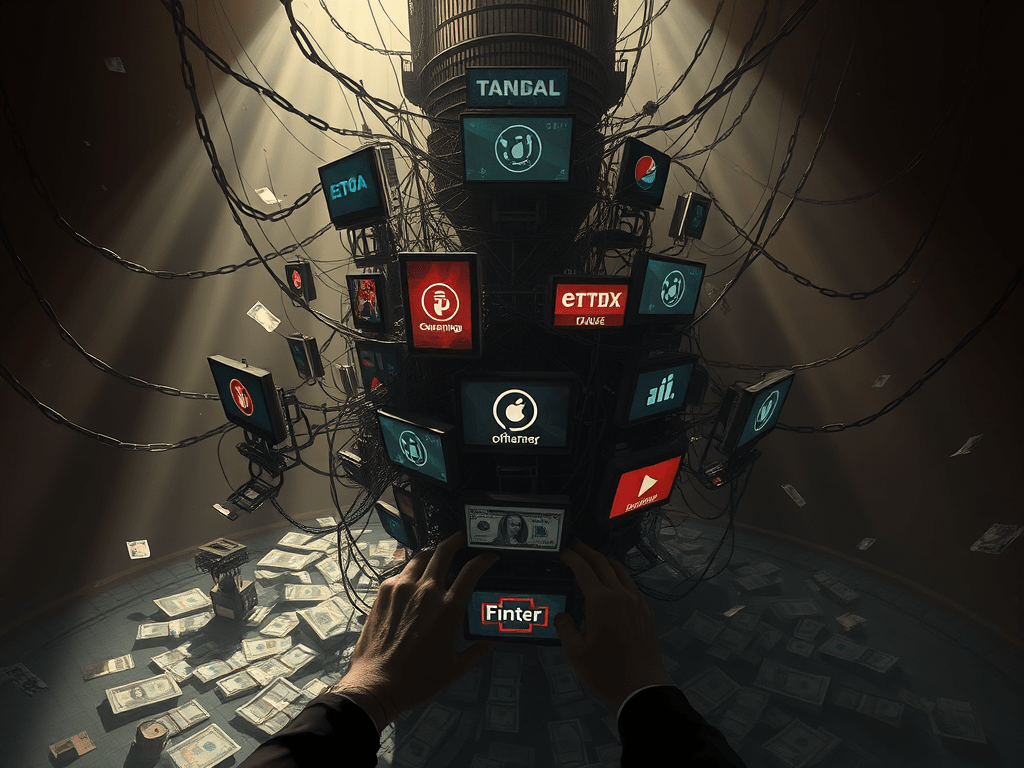
The Architects of Control
If power truly belongs to the people, why does it seem so unreachable? Why do the same patterns of corruption, deception, and manipulation persist across generations?
Because power, left unchecked, always seeks to consolidate itself.
Behind the illusion of choice, behind the chaos of politics and media, there exists a deliberate structure of control—not run by shadowy figures in secret rooms, but by well-documented forces that shape economies, societies, and even individual thought.
Who Are the Architects?
The architects of control are not a single group or ideology but a network of entities whose interests align around one principle: maintaining dominance over the majority. These forces include:
- Centralized Financial Powers – Global banks, private equity firms, and economic institutions that control debt, interest rates, and currency valuation. They do not create wealth; they extract it, ensuring that no nation, business, or individual becomes too independent.
- Corporate Conglomerates – A handful of multinational corporations own nearly everything you buy, watch, and consume. They fund politicians, shape policies, and manufacture demand to ensure dependence on their products and services.
- Media and Information Gatekeepers – Five companies control over 90% of the media. They determine what is newsworthy, frame narratives, and drown out dissenting perspectives, all while presenting the illusion of diverse viewpoints.
- Educational and Scientific Institutions – While knowledge should be liberating, education systems have been designed to create compliant workers, not independent thinkers. Grants, research funding, and curriculums are dictated by the same financial and corporate interests that benefit from a docile, predictable society.
- Government Bureaucracies – While politicians come and go, the unelected bureaucratic machine remains. These agencies are less about governance and more about gatekeeping—ensuring that policy changes never disrupt the entrenched power structure.
The Tools of Control
How do these forces maintain dominance without direct force? Through mechanisms that condition compliance:
- Debt and Economic Dependence – When people are in debt, they are easier to control. The system ensures that most will never be free from financial burdens, making them too busy surviving to question the system itself.
- Problem-Reaction-Solution – Crises (real or manufactured) are used to justify new controls. Every war, financial collapse, or social upheaval results in the expansion of government power or corporate influence.
- Division as a Strategy – Societies are kept in a state of conflict—left vs. right, race vs. race, citizen vs. immigrant—so that the masses never unite against those truly in control.
- Censorship and Narrative Control – Those who challenge the system are marginalized, discredited, or silenced. Not through brute force, but by labeling them as “extremists,” “conspiracy theorists,” or “threats to democracy.”
Breaking the Cycle
Recognizing these architects of control is not about fear—it is about clarity. The greatest weapon against control is awareness.
- Economic systems can be rebuilt.
- Decentralized media can expose the truth.
- Education can be reclaimed by communities.
- Governance can be restructured around transparency.
The architects of control exist only as long as the people accept their rule.
So the real question becomes: How do we dismantle the system without falling into the same traps?
Previous: Who Really Holds the Power?
Next: The Blueprint for Liberation – NEW!




 The Metaphorical
Leave a Reply