
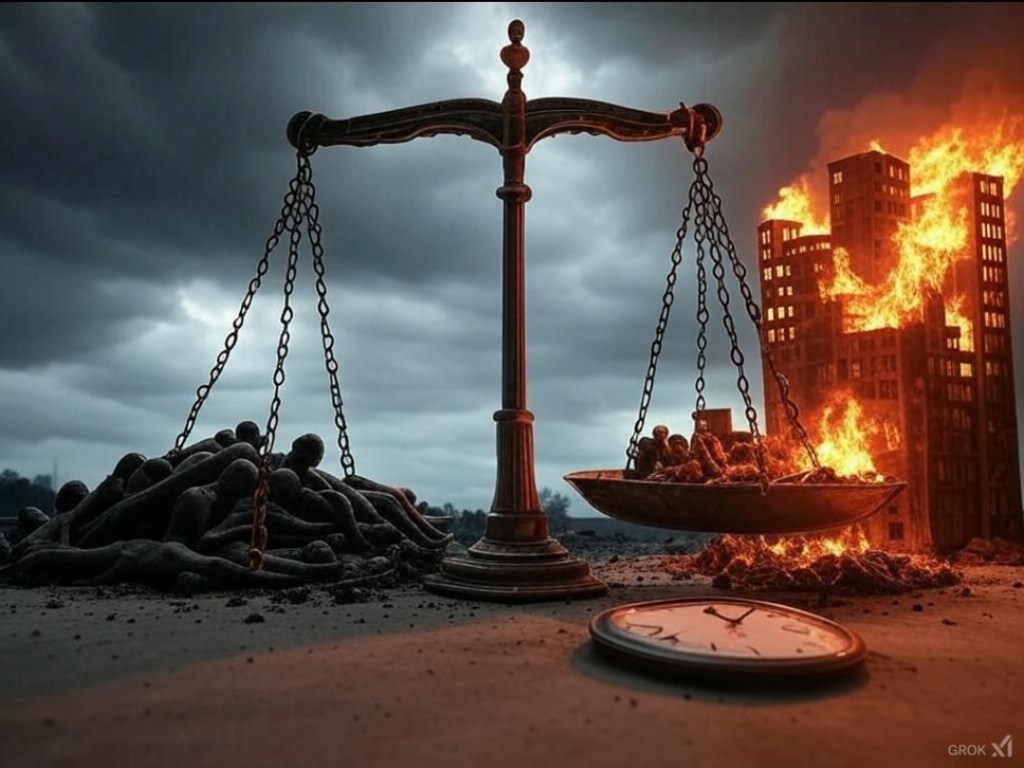
The perception of Volodymyr Zelensky as a dictator is largely based on criticisms of his actions during the war and his governance style. While many view him as a wartime leader defending Ukraine, others argue that his policies have eroded democratic principles. Here are some reasons critics cite when calling him a dictator:
- Banning Opposition Parties – In 2022, Zelensky banned several opposition political parties, including those with pro-Russian stances, claiming they were a national security threat. Critics argue this undermines political plurality.
- Censorship & Media Control – He consolidated all national TV channels into a single government-controlled broadcast, citing the need for unity during wartime. Critics say this restricts independent journalism.
- Suppressing Dissent – Reports suggest that journalists and activists critical of the government have been intimidated or arrested, leading to concerns about freedom of speech.
- Extended Martial Law & No Elections – He has continuously extended martial law, which suspends elections and grants the government extraordinary powers. Critics argue this is undemocratic, while supporters say it is necessary during war.
- Centralizing Power – Some claim he has concentrated power in his hands by sidelining parliament and making key decisions through executive orders.
- Crackdown on the Orthodox Church – His government has taken actions against the Ukrainian Orthodox Church (UOC), which has historical ties to Russia, including banning priests and seizing church properties. This has been seen as a violation of religious freedoms.
- Forced Conscription & Military Crackdowns – Ukraine has imposed strict conscription laws, with reports of military police forcibly drafting men. Some view this as authoritarian wartime governance.
- Targeting Political Rivals – His government has investigated and detained former President Petro Poroshenko and other political rivals, leading to accusations of using law enforcement to silence opposition.
- Western-Backed Leadership with No Accountability – Some argue that because of heavy Western financial and military support, Zelensky operates with less accountability to the Ukrainian people, making decisions unilaterally.
- Pushing for Greater Government Surveillance – Measures such as digital ID systems and wartime surveillance powers have raised concerns about privacy and authoritarian control.
Supporters argue that these measures are necessary due to the war, while critics believe they represent an erosion of democracy.
Before becoming president, Volodymyr Zelensky was a comedian, actor, and producer with no prior political experience. Here’s a breakdown of his career before politics:
- Comedy & Acting Career – Zelensky was a well-known entertainer in Ukraine, rising to fame through his work in comedy and television.
- He co-founded the Kvartal 95 comedy group in the late 1990s, which became one of Ukraine’s top entertainment companies.
- He starred in and produced numerous comedy shows, including “Vechirniy Kvartal” (Evening Quarter).
- “Servant of the People” (2015-2019) – His most famous role was playing a schoolteacher who accidentally becomes president of Ukraine after a viral rant against corruption.
- The show was a huge success and directly inspired his real-life presidential run.
- Film Career – Zelensky starred in multiple films, including:
- Love in the Big City (2009, 2010)
- 8 First Dates (2012)
- Rzhevsky Versus Napoleon (2012)
- Voice Acting – He was the Ukrainian voice of Paddington Bear in the animated movies Paddington (2014) and Paddington 2 (2017).
- Business & Entertainment Leadership – As head of Kvartal 95, he produced films, TV shows, and comedy programs. The company had strong ties to Ukraine’s media and entertainment industry.
- Law Degree (But No Legal Practice) – He earned a law degree from Kyiv National Economic University but never worked as a lawyer, going straight into entertainment.
- Presidential Run (2018-2019) – He launched his campaign under the “Servant of the People” party (named after his TV show). His campaign was highly untraditional, relying on social media and entertainment-style outreach rather than traditional political methods.
His victory in 2019 was seen as a rejection of Ukraine’s political establishment, as he ran on an anti-corruption, pro-reform platform.
From Comedian to Controversial Leader: How Zelensky’s Past Ties to His Present Leadership
Volodymyr Zelensky’s rapid rise from comedian and actor to president of Ukraine mirrors a pattern seen throughout history: entertainers or outsiders who gain power through popularity but struggle with the realities of leadership, often resorting to authoritarian measures to maintain control. His lack of political experience may have led to centralizing power, restricting opposition, and suppressing dissent—hallmarks of leaders who claim emergency powers but ultimately lose legitimacy over time.
How His Entertainment Background Plays a Role
- As an actor and comedian, Zelensky mastered public perception and messaging, which helped him win public support in a landslide 2019 election.
- His TV show, “Servant of the People,” blurred the line between fiction and reality—he played a humble teacher-turned-president who fights corruption, a persona he later embodied in real life.
- As a media-savvy leader, he effectively used wartime propaganda and Western media appearances to maintain global support.
However, as war intensified and his leadership was tested, his governance shifted toward authoritarian tactics to consolidate control—banning opposition parties, restricting media, and eliminating elections under martial law. While some argue these measures are necessary for wartime leadership, others see them as a dictator’s playbook.
Historical Parallels: Leaders Who Took Similar Paths and Failed
- Juan Perón (Argentina, 1946-1955, 1973-1974)
- Rode to power on charisma and media influence (former military officer, used radio speeches to win public support).
- Silenced opposition, controlled media, and expanded government power.
- Eventually exiled in a coup (1955) as economic turmoil and authoritarian rule turned the people against him.
- Hugo Chávez (Venezuela, 1999-2013)
- Used populist rhetoric and media spectacle to gain control.
- Shut down independent media, arrested opposition leaders, and centralized power under the guise of “protecting democracy.”
- Left Venezuela in economic collapse, with his successor, Nicolás Maduro, following the same path into dictatorship.
- Ferdinand Marcos (Philippines, 1965-1986)
- Used martial law to suspend elections, arrest opposition, and stay in power.
- Portrayed himself as a national hero, but his rule ended in economic disaster and mass protests.
- Overthrown by a people’s revolution (1986) after years of corruption and repression.
- Alexander Lukashenko (Belarus, 1994-Present)
- Started as a populist “man of the people” but eliminated opposition over time.
- Used emergency powers to ban opponents, rig elections, and control the media.
- Now considered Europe’s last dictator, with widespread protests against his rule.
Where Zelensky’s Path May Lead
While Zelensky still enjoys Western support, his reliance on authoritarian measures raises concerns that Ukraine may not return to true democracy. History suggests that leaders who restrict freedoms under the excuse of crisis eventually lose public trust, face economic instability, or are forced out—either by their own people or external forces.
If Ukraine cannot transition back to democratic norms after the war, Zelensky risks following the fate of Perón, Marcos, or Chávez—leaders who started with popular support but ended in failure due to authoritarian overreach.
Vladimir Putin
Before becoming the leader of Russia, Vladimir Putin had a career in intelligence, politics, and government administration. Here’s a breakdown of his path to power:
1. KGB Career (1975–1991)
- Trained as an intelligence officer in the KGB (Soviet Union’s secret police and intelligence agency) after graduating from Leningrad State University with a law degree.
- Stationed in Dresden, East Germany (1985–1990), where he worked in counterintelligence and gathered intelligence on NATO and Western officials.
- Witnessed the collapse of the Berlin Wall in 1989, which shaped his later views on Russian power and the West.
- Left the KGB in 1991 after the Soviet Union began to collapse, officially resigning with the rank of Lieutenant Colonel.
2. Political Rise in St. Petersburg (1991–1996)
- Became an advisor to the mayor of St. Petersburg, Anatoly Sobchak, who was one of the leading reformers in post-Soviet Russia.
- Promoted to deputy mayor (1994), managing foreign trade and investment in the city.
- Gained a reputation as a loyal, efficient administrator and developed key political connections.
3. Kremlin Bureaucrat (1996–1999)
- Moved to Moscow in 1996 after Sobchak lost re-election.
- Joined the administration of President Boris Yeltsin, working in the Presidential Property Management Department.
- By 1998, he became the head of the FSB (successor to the KGB), where he oversaw intelligence operations and built influence within the government.
- Appointed Prime Minister of Russia in 1999, a position used as a stepping stone to the presidency.
4. Becoming President (1999–2000)
- Boris Yeltsin unexpectedly resigned on December 31, 1999, making Putin acting president of Russia.
- Won the 2000 election, largely due to his promise to restore stability after the economic collapse of the 1990s and his handling of the Second Chechen War.
From there, he steadily consolidated power, reshaping Russia into a highly centralized state under his leadership.
Vladimir Putin’s legacy is deeply controversial, with strong opinions on both sides. However, if we focus on policies or actions that some have viewed as noble or beneficial, here are a few:
- Stabilizing Russia’s Economy (Early 2000s) – After the chaotic 1990s, Putin’s policies helped restore economic stability, paying off international debt and growing Russia’s GDP.
- Reducing Poverty & Improving Living Standards – Under his leadership, Russia saw a reduction in extreme poverty and a rise in average incomes in the early years.
- Reviving National Identity & Pride – Many Russians credit him with restoring national pride after the collapse of the Soviet Union.
- Infrastructure & Development Projects – Investments in roads, transportation, and energy infrastructure have modernized parts of Russia.
- Space Exploration Support – Under Putin, Roscosmos continued space advancements, including cooperation with the ISS and the development of new space programs.
- Opposition to Unipolar World Order – While controversial, some view his efforts to counterbalance U.S. global dominance as a push for a multipolar world.
- Promoting Domestic Agriculture – His response to Western sanctions included boosting Russian agriculture, making the country more self-sufficient in food production.
- Hosting International Events – Russia successfully hosted global events like the 2014 Winter Olympics in Sochi and the 2018 FIFA World Cup.
- Preservation of Russian Orthodox Church – His administration has strengthened ties with the church, which some see as preserving Russian cultural heritage.
- Wildlife & Environmental Efforts – Putin has personally promoted conservation efforts for endangered species like tigers, leopards, and polar bears.
Of course, these are aspects viewed positively by some, while others argue that his leadership has come with significant drawbacks. It depends on perspective.
When comparing Volodymyr Zelensky and Vladimir Putin as candidates for a leadership position, it’s essential to evaluate their backgrounds, leadership styles, and the outcomes of their governance. Here’s an objective comparison:
Background and Experience
- Volodymyr Zelensky
- Entertainment Industry: Prior to his presidency, Zelensky was a comedian and actor, gaining national fame in Ukraine.
- Political Outsider: His transition from entertainment to politics marked a significant shift, bringing a fresh perspective but limited political experience.
- Vladimir Putin
- KGB Officer: Putin served as an intelligence officer in the KGB for 16 years, including a stint in East Germany.
- Political Ascendancy: Post-KGB, he held various governmental roles, including Deputy Mayor of St. Petersburg, before rising to the presidency.
Leadership Styles
- Volodymyr Zelensky
- Transformational Leadership: Zelensky is often viewed as a transformational leader, inspiring resilience and unity among Ukrainians during challenging times. citeturn0search6
- Empathy and Humility: His leadership is characterized by empathy, humility, and a willingness to collaborate with international partners. citeturn0search2
- Vladimir Putin
- Authoritarian Leadership: Putin’s leadership is marked by a centralized power structure, with limited tolerance for political opposition. citeturn0search1
- Commanding and Assertive: He exhibits a commanding demeanor and confident assertiveness, focusing on projecting strength and stability. citeturn0search5
Governance and Outcomes
- Volodymyr Zelensky
- Democratic Aspirations: Despite challenges, Zelensky has aimed to uphold democratic principles, seeking closer ties with Western nations.
- Crisis Management: His leadership during the Russian invasion has been lauded for resilience and effective communication.
- Vladimir Putin
- Economic Stabilization: Under Putin, Russia experienced economic growth in the early 2000s, largely due to rising oil prices.
- International Controversies: His tenure has been marked by international disputes, including conflicts with neighboring countries and allegations of election interference.
Conclusion
Determining “the better person” and “the better leader” depends on the criteria used:
- The Better Person: If valuing empathy, humility, and a collaborative spirit, Zelensky’s background and leadership style align with these traits.
- The Better Leader: If prioritizing experience, assertiveness, and a focus on national stability, Putin’s extensive background in governance and intelligence may be seen as advantageous.
However, leadership effectiveness also depends on context, goals, and ethical considerations. It’s essential to weigh these factors based on the specific requirements of the role in question.
1. Integrity & Ethics
- Zelensky: Advocates for democratic values, transparency, and governance reforms. However, he has been criticized for restricting opposition media and banning political parties during wartime.
- Putin: Has a track record of consolidating power, suppressing dissent, and being involved in corruption scandals. His government has been linked to assassinations of political opponents and journalists.
Advantage: Zelensky (despite his wartime measures, his governance aligns more with democratic principles).
2. Leadership & Crisis Management
- Zelensky: Shown resilience during the Russian invasion, effectively rallying his people and securing international support. However, his military experience is limited, and he has faced criticism for certain tactical decisions.
- Putin: Highly experienced in strategic statecraft and military operations, but his leadership has also led to costly wars (Chechnya, Ukraine). His handling of crises is decisive, but often at great humanitarian cost.
Advantage: Putin (more strategic long-term planner, but at a moral cost).
3. Political & Administrative Competence
- Zelensky: Entered politics with no prior experience, making some early governance mistakes but learning quickly. His focus is on international diplomacy and defense.
- Putin: Decades of experience in governance, intelligence, and economic management. He transformed Russia into a global power but at the expense of political freedoms.
Advantage: Putin (far more experienced in administration and power consolidation).
4. Popular Support & Legitimacy
- Zelensky: Elected in a landslide victory (73% of the vote in 2019), initially on an anti-corruption and reform platform. His wartime leadership has boosted his approval ratings.
- Putin: Also highly popular in Russia (approval ratings often above 60%), but his elections have been marred by allegations of fraud and suppression of opposition.
Advantage: Zelensky (more transparent and democratic election process).
5. Global Influence & Diplomacy
- Zelensky: Strengthened Ukraine’s ties with NATO and Western allies, securing military aid and diplomatic backing.
- Putin: Commands greater global influence due to Russia’s military power, energy dominance, and alliances (China, BRICS). However, he is also a major antagonist to the West.
Advantage: Putin (more influence on global geopolitics).
Conclusion: Who is the Better Person?
- Zelensky wins as the “better person” due to his emphasis on democracy, transparency, and ethical leadership, despite some wartime restrictions.
- Putin’s record includes authoritarian control, suppression of opposition, and aggressive foreign policies that undermine moral leadership.
Conclusion: Who is the Better Leader?
- Putin is the “better leader” if the metric is power consolidation, long-term strategic governance, and geopolitical influence.
- Zelensky is the “better leader” in terms of inspiring resilience and democratic values, but his leadership is largely defined by crisis management rather than long-term governance.
Ultimately, it depends on what qualities one values more in leadership—moral integrity and democracy (Zelensky) vs. strategic dominance and realpolitik (Putin).
A peace agreement between Zelensky and Putin is theoretically possible, but there are significant challenges that make it unlikely in the near term.
1. Is a Peace Agreement Possible?
Yes, a peace deal is possible, but it depends on key factors:
- Mutual Interests: Both sides would need to see more benefit in ending the war than continuing it.
- International Pressure: If global powers (U.S., EU, China) push for negotiations, peace could become more realistic.
- Domestic Pressures: If the war becomes too costly or unpopular at home, leaders might seek an off-ramp.
Currently, neither side appears willing to compromise on core demands.
2. What Would a Peace Deal Look Like?
For an agreement to happen, it would likely include:
A. Ukraine’s Requirements (Zelensky’s Stance)
✔ Full sovereignty over Ukrainian territory (including Crimea & Donbas).
✔ Security guarantees from NATO or other international coalitions.
✔ War reparations from Russia.
✔ Prosecution of Russian war crimes.
B. Russia’s Requirements (Putin’s Stance)
✔ Ukraine must remain neutral (no NATO membership).
✔ Recognition of Russian control over Crimea and possibly parts of Donbas.
✔ Lifting of Western sanctions on Russia.
✔ Demilitarization or limitation of Ukrainian forces.
The problem? These demands are irreconcilable right now. Neither leader is willing to accept terms that would be seen as a major defeat.
3. What Are the Obstacles to Peace?
A. Leadership Stubbornness & Public Perception
- Zelensky cannot politically accept losing territory—doing so would be seen as betraying Ukraine’s sovereignty.
- Putin cannot afford to “lose” the war—a weak peace deal could threaten his grip on power in Russia.
B. Military Realities
- If Russia gains ground, Putin has no incentive to negotiate.
- If Ukraine pushes Russia back, Putin might escalate (even nuclear threats).
C. External Influence
- The West continues to supply Ukraine with weapons, making Kyiv less likely to compromise.
- China and other allies back Russia, giving Putin confidence to keep going.
4. Historical Comparisons: When Have Leaders Like Them Made Peace?
There are some historical examples where bitter enemies did make peace:
- Korean Armistice (1953) – Neither North nor South Korea “won,” but they agreed to a ceasefire.
- U.S. and Vietnam (1973) – After years of fighting, the U.S. withdrew, leading to Vietnam’s unification.
- Egypt and Israel (1979) – After multiple wars, Egypt recognized Israel in exchange for Sinai.
But in all these cases, one side ultimately compromised more than the other—which Putin and Zelensky don’t seem willing to do yet.
5. How Could a Peace Agreement Happen?
Here are some scenarios where peace becomes more likely:
A. Military Stalemate → Ceasefire (Most Likely Short-Term Outcome)
- If neither side can win outright, they might agree to pause fighting (like the Korean War).
- This could be a temporary truce, leading to a long-term frozen conflict.
B. Russian Political Change → Negotiation Window
- If Putin is removed from power (coup, retirement, etc.), a new Russian leader might be more open to peace.
- However, this depends on whether his replacement is more aggressive or more pragmatic.
C. Western Pressure on Ukraine → Concessions
- If the U.S. and NATO reduce military aid, Ukraine might be forced into accepting a deal (though unpopular).
- This would likely mean giving up Crimea and Donbas permanently.
D. China and Global Powers Push Russia to Negotiate
- China and India have economic leverage over Russia and could pressure Putin to settle if the war becomes too costly.
- But so far, China has backed Russia indirectly, making this less likely.
6. Conclusion: What’s the Most Realistic Path?
- Short-term? → A ceasefire with frozen territorial disputes is the most likely outcome.
- Long-term? → A negotiated peace deal could happen if military realities force one side to back down or if leadership changes.
- Least likely? → Ukraine fully retaking its land or Russia fully conquering Ukraine.
While a peace deal is not impossible, neither side is currently willing to accept a compromise that would be seen as a loss—which is why the war continues.
If nothing changes, meaning the war continues without a decisive victory or peace agreement, several long-term consequences will unfold. The situation would likely turn into a prolonged conflict or a frozen war, similar to past unresolved wars.
1. The Most Likely Outcomes if Nothing Changes
A. A Stalemate and Frozen Conflict (Like Korea or Israel-Palestine)
- If neither side can achieve a decisive military victory, the war may drag on indefinitely.
- Fighting could become sporadic, with some active battles and periods of ceasefire.
- Ukraine could remain partially occupied, much like North and South Korea, where no official peace exists.
Example:
- The Korean War (1950-1953) never officially ended, leading to a permanent division between North and South Korea.
B. Ukraine Becomes Like Afghanistan (A Never-Ending Warzone)
- If Russia keeps attacking but never fully wins, Ukraine could become a permanent warzone.
- The West would keep supplying weapons, and Ukraine would keep fighting, but the country would remain devastated.
- Russia, like the Soviets in Afghanistan (1979-1989), might struggle with an endless insurgency.
Example:
- The Soviet-Afghan War showed how a superpower can get stuck in a war it cannot win.
- The U.S. war in Afghanistan (2001-2021) is another example of a long, unwinnable war that ended with withdrawal.
C. Global Exhaustion Forces a Ceasefire
- If the war continues for years, global economic and political pressures could force a reluctant truce.
- This might happen if:
- The U.S. and EU reduce support for Ukraine due to war fatigue.
- Russia struggles with sanctions and internal unrest.
- Countries like China pressure Russia to stop fighting for economic stability.
Example:
- The Iran-Iraq War (1980-1988) ended because both sides were too exhausted to continue, even though no clear winner emerged.
2. The Consequences of a Never-Ending War
A. Humanitarian Crisis Deepens
- Millions more Ukrainians could die, be injured, or flee their homes.
- Ukraine’s economy and infrastructure would collapse further.
- More war crimes, atrocities, and suffering.
Example: Syria’s civil war dragged on for over a decade, devastating the country beyond repair.
B. Russia Becomes More Isolated and Economically Strained
- Sanctions will continue to weaken Russia’s economy, making life harder for ordinary Russians.
- Military losses will increase, hurting Russia’s global power and influence.
- Internal resistance to Putin could grow, but if nothing changes, he could tighten control even more.
Example: The Soviet Union collapsed partly due to the economic burden of war (Afghanistan, Cold War arms race).
C. Ukraine Remains Dependent on Foreign Aid
- Without a clear victory, Ukraine will remain heavily reliant on Western military and economic support.
- If Western nations grow tired of funding the war, Ukraine could lose momentum and face collapse.
Example:
- South Vietnam fell in 1975 after the U.S. cut military support.
- Afghanistan’s government collapsed as soon as the U.S. left in 2021.
3. What Happens to Putin and Zelensky If Nothing Changes?
A. Putin’s Future
- If the war drags on with no clear win, his grip on power could weaken.
- Elite dissatisfaction could lead to internal opposition or a coup attempt.
- However, if he keeps suppressing dissent, he could stay in power indefinitely, like Stalin or Assad.
Example:
- Soviet leaders who failed in war (e.g., Khrushchev after the Cuban Missile Crisis) were removed.
B. Zelensky’s Future
- If Ukraine never wins, his popularity could decline over time.
- He might lose re-election or face pressure to negotiate peace.
- But if he remains a wartime leader without victory, he could face internal opposition.
Example:
- Leaders like Winston Churchill were celebrated in wartime but lost elections afterward.
4. Final Conclusion: What Does a Never-Ending War Mean?
If nothing changes, the world will face:
✔ A prolonged conflict with no resolution.
✔ A humanitarian disaster with continued suffering.
✔ A drained Ukraine, dependent on the West.
✔ A weaker Russia, but still authoritarian.
✔ A global economic strain, affecting energy and food prices.
It wouldn’t be the first time a war dragged on indefinitely, but history shows all long wars eventually end—either through a truce, exhaustion, or the downfall of one of the key leaders.
Conclusion: The Cost of Stagnation
If nothing changes, the Russia-Ukraine war will become a never-ending conflict, much like Korea, Afghanistan, or the Israel-Palestine situation. Both sides will suffer military, economic, and human losses, while the global economy remains strained.
For Russia, prolonged war means further isolation, economic decline, and potential internal instability. For Ukraine, continued conflict means dependence on foreign aid, destruction of its economy, and an uncertain future for Zelensky’s leadership.
Ultimately, history shows that wars without decisive victories tend to end through exhaustion, economic collapse, or leadership change. If no peace deal is reached, the war will continue until one side is too weak to fight or external forces force a resolution.
The longer this drags on, the higher the cost for both nations and the world—but in the end, every war must end. The real question is: will it end by choice, or by force of circumstance?




Leave a Reply